

TerraHaus Student Residence Hall
Category
Institutional, Passive HouseAbout This Project
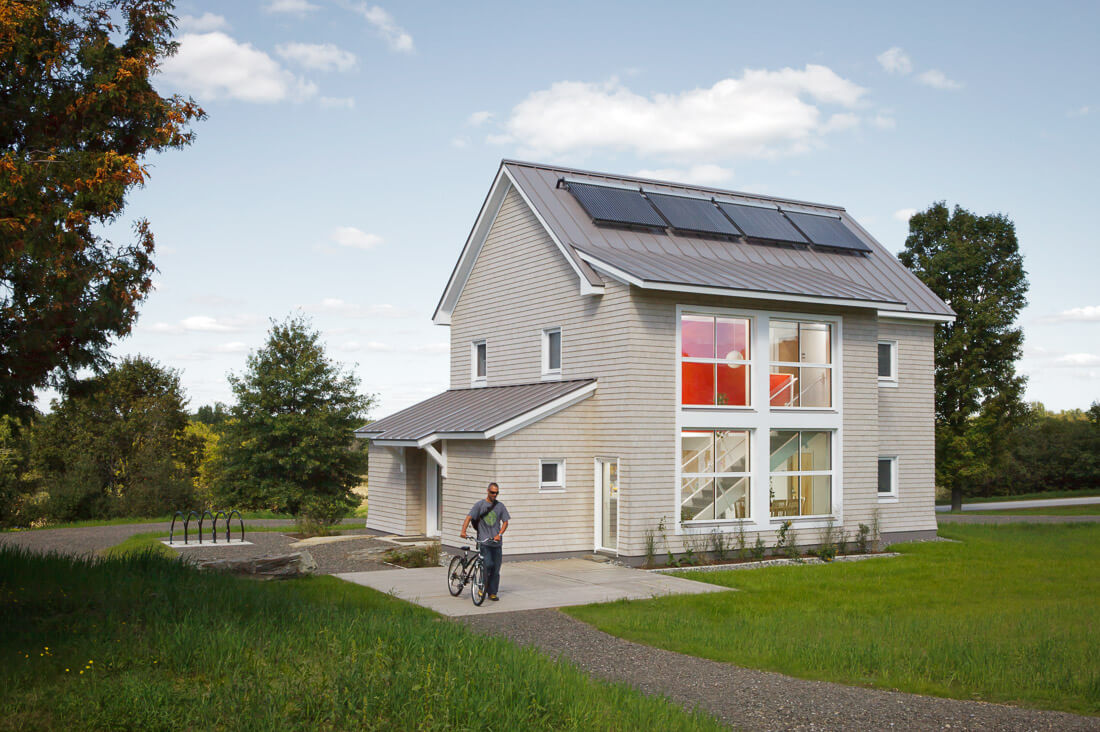
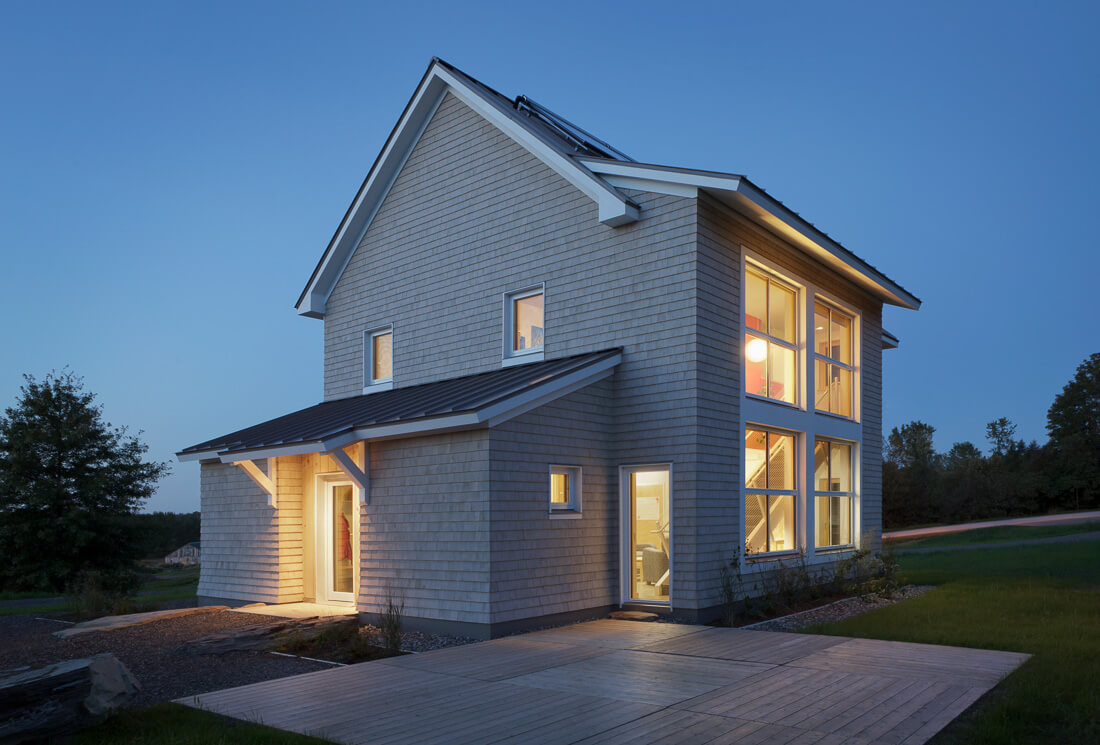
TerraHaus is a 2,100 square-foot student residence hall built on Unity College’s campus in Maine. The construction was completed on time and on budget in three months in August 2011. TerraHaus is the first Passive House–certified residence hall in North America, and was recently awarded a 2012 AIA New England Design Award, 2012 Evergreen Award from Eco-Structure magazine, EcoHome’s Grand Award, and a Builders Choice award from Builder Magazine.
The goal of the project was to redevelop a portion of the existing campus, replacing six small, inefficient, and deteriorated student-housing structures with three new energy-efficient residence halls. The project required a portion of the existing campus to be redesigned, allowing for the phased demolition and rebuilding of the site. TerraHaus is the first of the new residence halls.
GO Logic and Ann Kearsley Design collaborated to develop the site plan for the project and to site and design TerraHaus, Phase I of a three-dorm development. The design team worked with the college administration, faculty, and students in a series of design charrettes to develop the concept and character of the new student residence hall. A goal of the project was to involve the student body in the design process, as well as create educational opportunities around the project to further the knowledge and awareness of sustainability and the Passive House standard. The design team engaged with the student body, providing a series of lectures about the design and technology behind the TerraHaus and the Passive House standard. Energy monitoring systems were installed in the completed building to measure energy performance, providing further educational feedback on building energy consumption for the students.
Site Work and Orientation
A primary goal of the site redesign was to maximize the density of the existing developed area on campus, move parking to the perimeter of the pedestrian areas, and repair the ecology damaged by the previous buildings. The decision to demolish the existing buildings and replace them with three new residence halls allowed that area of campus to be re-examined regarding its pedestrian infrastructure and the variety of plantings and landscape. TerraHaus was located proximate to the campus’s main access road and oriented 12.5 degrees to the east of solar south. The design intent was to consciously restrict the construction area to a small portion of the property in Phase I, while using the building to create a new pedestrian infrastructure (to better connect the building site with the larger campus). A slab-on-grade foundation system was chosen to reduce the amount of excavated soils. The construction staging was pre-planned to avoid unnecessary soil compaction and vegetation removal as well.
Foundation
The foundation system is a frost-protected, shallow foundation consisting of a super-insulated, reinforced concrete slab-on-grade with an effective R-value of R70. The super-insulated concrete slab provides not only a durable interior finish but also acts as a thermal mass to moderate temperature fluctuations achieved by passive solar gain.
Building Envelope
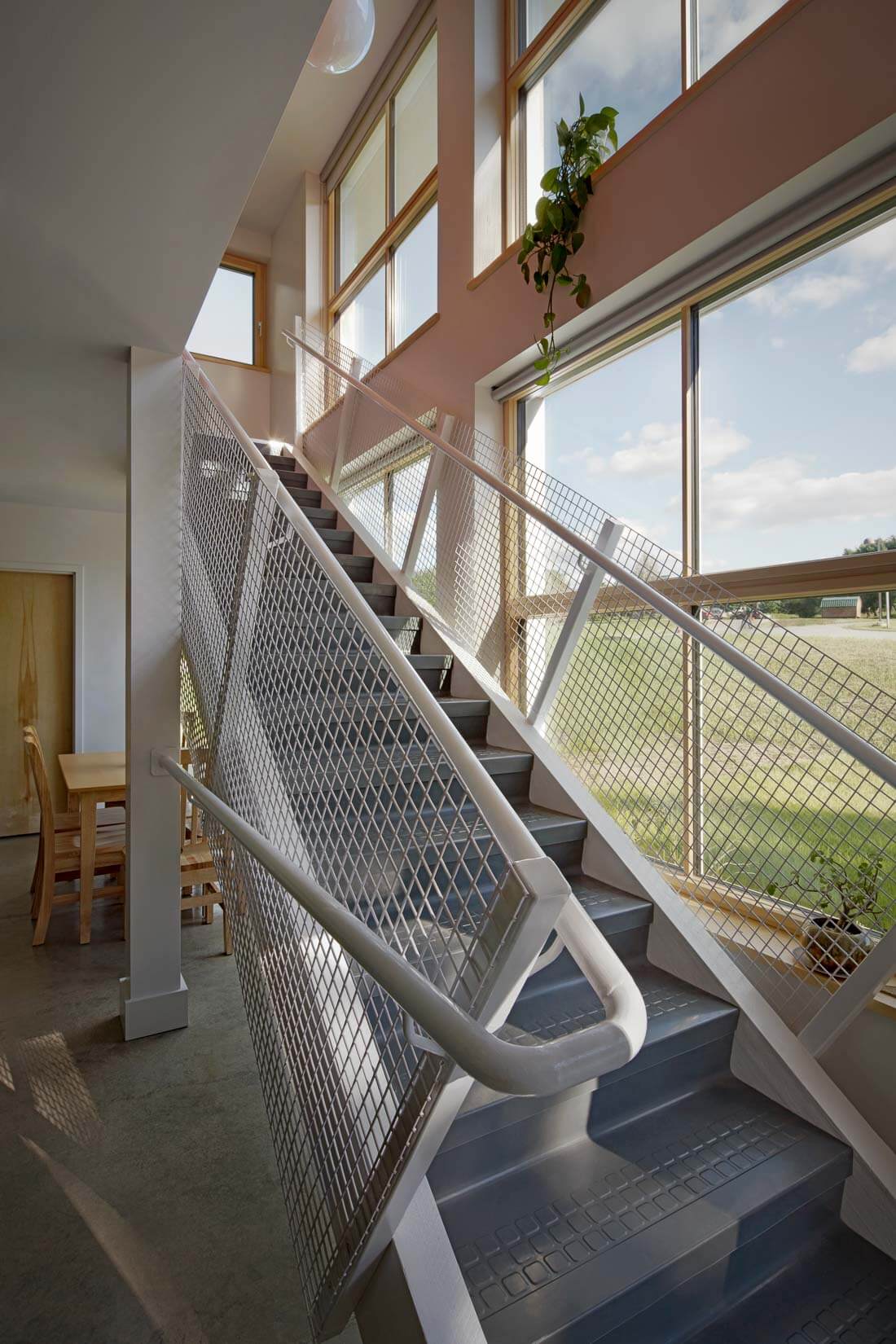
TerraHaus’s compact form and construction was conceived as a response to the climate and microclimate in which it is built. Unity, Maine, registers 7,400 heating degree-days, qualifying it as a “cold” climate. Given the relatively clear skies during the winter months however, it is an excellent candidate for passive solar gain to offset building heat loss. In response to these conditions, TerraHaus’s building form is compact and exceptionally well-insulated, with large, triple-glazed windows oriented toward the south. The building was located on the site to ensure solar access to the south while making use of an orchard’s edge at the property’s northern boundary to temper the prevailing winter winds. The vertical stair circulation within TerraHaus was located in a two-story glazed projection on the south facade. This was done to allow for passive solar gain into the public spaces on two floors, while not overheating the smaller private rooms. The stair also acts to visually screen the public spaces from the large south-facing windows, creating privacy for the inhabitants while maintaining the ability to utilize passive solar gain. The visual impact of the stair crossing the four huge southern windows provides unexpected geometric relief across an otherwise traditional orthogonal facade. Doors and windows were manufactured in Germany to ensure performance and durability.
In addition, TerraHaus is built to the Passive House standard, which requires that the building shell reduce the space-heating load by 90% from code-compliant construction. This improvement on energy performance allows the residence hall’s remaining heat load to be cost-effectively accommodated by a small air-source heat pump, which, in conjunction with a large solar thermal system for domestic hot water, energy-efficient lighting, and appliances results in a near-zero-energy building on an annual basis.
The optimization of materials used during the construction process is environmentally beneficial as well as cost-effective. The design and construction of TerraHaus was an integrated process, which utilized computer modeling directly in the construction process. Specifically, the building shell is constructed using structurally insulated panels that were patterned and optimized on the computer, making the most efficient use of the materials. The computer file was then exported to a fabricator who cut the panels with CNC technology. All waste materials were fully recycled in the factory. TerraHaus‘s building shell is also constructed to be durable, using high-quality interior and exterior materials. Moisture-control measures include a sealed warm-side air barrier on the interior and vented cladding materials on the exterior to ensure the building shell’s longevity. Overall wall R-value of 50 was achieved with a combination of structural insulated panel and blown-in fiberglass insulation, while roof areas were insulated with blown cellulose from R80 to R100.
Interior Finishes
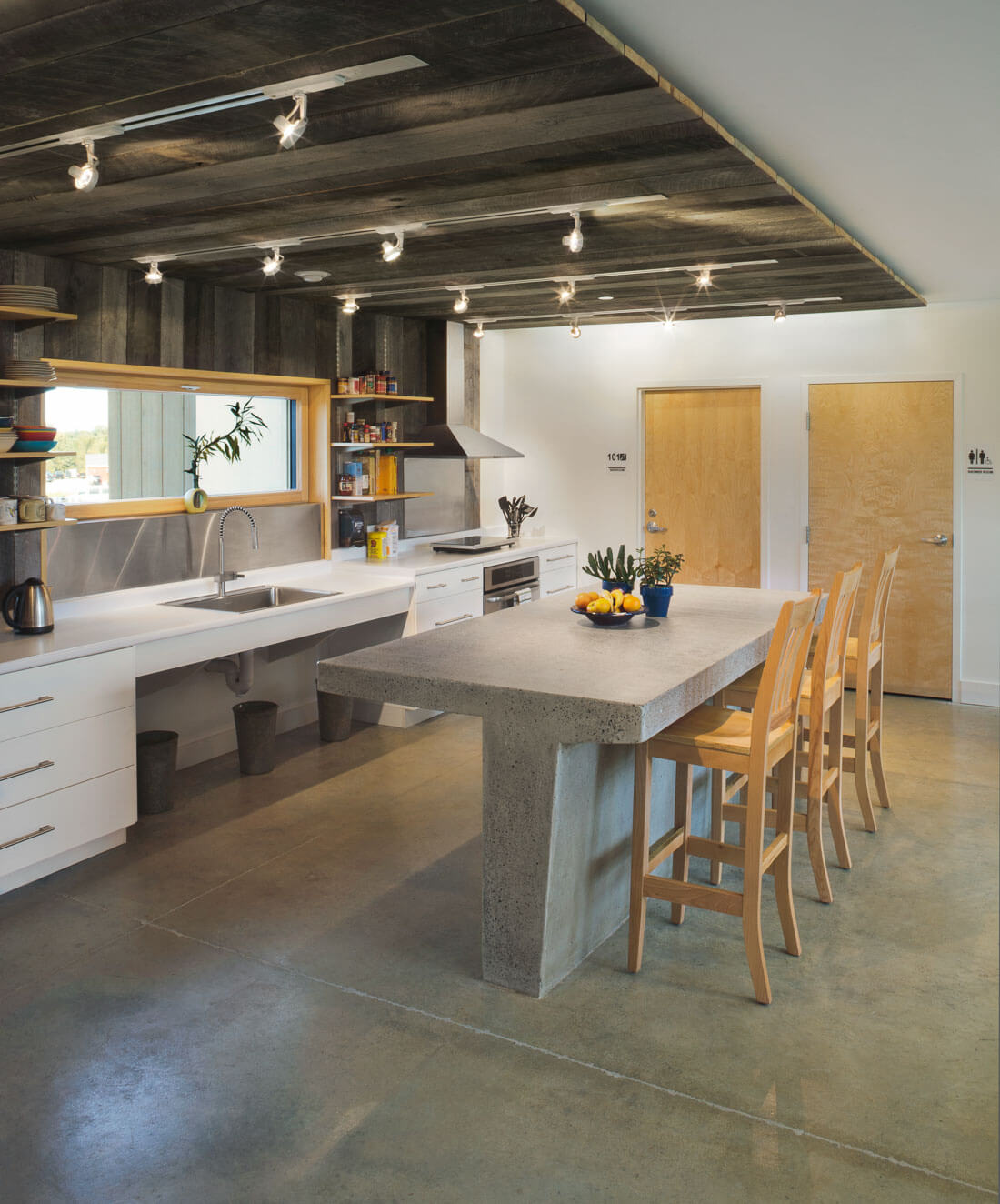
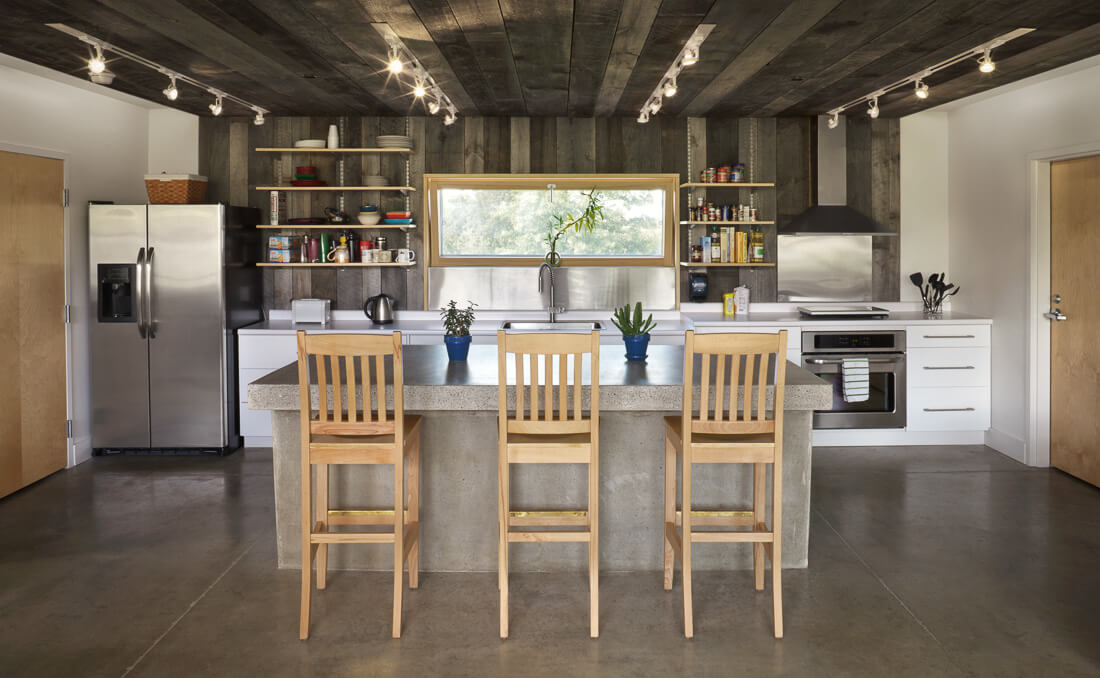
The first floor is an exposed concrete slab that acts as a thermal mass to store passive solar energy and then re-radiate it at night. To further optimize the amount of thermal mass in the building, a beautiful, cantilevered concrete island was cast between the kitchen and the common space. This element had not only a critical building bioclimatic function, but it also helps create the regional rustic atmosphere of the interior. To further enhance this quality, weathered barn boards were applied to the north wall and ceiling of the kitchen to add warmth and definition to the overall common area while balancing the light from the open southern facade.
The stairway itself utilizes durable vinyl for the treads, painted steel for the handrails, and lobster-cage mesh for the guardrails, which not only fulfill a necessary function but also further invoke the regional rustic atmosphere throughout the common area.
Additionally, interior finishes consist of painted acrylic walls, ceiling, and trim using Sherwin Williams Harmony No-VOC paint. The concrete floors were treated with a sealer to provide durability. Armstrong Marmorette natural linoleum flooring was used throughout the second floor to provide an accent color and durability.
HVAC
Given the targeted budget and affordability goals for appropriate lighting and interior air quality in TerraHaus, the focus of the well-insulated and air-tight building shell was to achieve interior thermal comfort, light, and air through simple or passive means, thereby reducing the need for complex and costly mechanical systems. The building maintains constant indoor temperatures, and is exceptionally well air-sealed (registering 0.58 ACH50 with a blower door test). A Zehnder ComfoAir 550 heat recovery ventilation system rated by the Passive Haus Institute at 88% efficiency provides fresh air in the bedrooms and living rooms, constantly supplying them with filtered and tempered outdoor air, while exhaust air is drawn from the bathrooms and kitchen where moisture and odors are created. During the summer months, passive cooling is provided by cross ventilation from operable windows on the east and west elevations of the building. A Daikin AC air-source heat pump supplements heating needs in the winter and provides cooling during the summer.
Reducing the space-heating demand of new construction in a cold climate has a significant environmental benefit, and if properly designed, a critical first-cost and life-cycle cost savings as well. Because TerraHaus’s energy demand for space heating has been reduced by 90%, the resulting heat required to keep the build at 70 degrees is very low; 2,638W peak demand for 1,560 square feet of living space. This allows TerraHaus’s traditional heating system to be drastically simplified with an air-source heat pump for the primary space heating load and a small amount of electric baseboard controlled by thermostats in each bedroom for back-up heating. The significant financial savings resulting from minimizing the heating systems is reinvested in the building-shell improvements, including walls at R49, foundation at R70, roof at R100, and triple-glazed R8 Passive House–certified windows and doors by Kneer-Sud Fenster. The combination of these improvements, in conjunction with heat recovery ventilation, results in a residence hall with energy costs for space heating at less than $300 per year, or $30/student/year. TerraHaus is replacing two existing, poorly insulated resident housing structures. The total space heating costs for these structures was $500/student/year. TerraHaus is expected to save a total of $3,700 in space heating a year with energy costs savings over 30 years of $350,000 (assuming energy inflation at 7% per year), which is two-thirds of the original cost of construction.
Electrical and Lighting
Compact fluorescent and halogen bulbs are used for lighting throughout the majority of the residence hall. Kitchen appliances are Energy Star–rated.
Kitchen and Bath
A mix of low-flow plumbing fixtures, including faucets, showerheads, and toilets, are used in the kitchen and bathrooms. Kitchen cabinets are IKEA and custom casework, both which are formaldehyde-free. The kitchen island is cast-in-place concrete with a ground, polished finish. Adjustable open shelving in the kitchen offers flexible storage and efficient use of space.
Alternative Energy
A solar thermal system comprised of 120 Apricus evacuated-tube solar thermal collectors and two 119-gallon Caleffi hot-water storage tanks was engineered to provide roughly 80% of the building’s domestic hot-water demand for 10 occupants.
Homeowner Education and Follow-up
TerraHaus was conceived as a living laboratory from inception through construction to habitation and monitoring. During the design process, the architect and contractor gave three lectures on campus to educate the students and community about the project and the Passive House standard. During construction, videos were made about the process with explanations about material systems and performance.
TerraHaus also utilizes two energy-monitoring systems installed within the building, which record and document its energy use and thermal comfort. The eMonitor by Powerwise displays energy-use information on a website in real time and logs data indefinitely. In addition, a WEL system monitors solar hot water production and efficiency along with interior temperatures and air quality.
Complete data for February 2012 determined total energy use for the building at 866kWhr, or $130 of electricity at $0.15/kWh for 10 people. Students will continue to monitor energy use and incorporate data into coursework.
TerraHaus is the first Passive House–certified dorm in North America, and was recently awarded a 2012 AIA New England Design Award, 2012 Evergreen Award from Eco-Structure magazine, EcoHome’s Grand Award, and a Builders Choice award from Builder Magazine.
Photography © Trent Bell