

26 Oct Wood Manifesto, Part 1
When we launched GO Logic in 2008, Passive House was virtually unknown in the U.S. But we recognized in this approach to building design and construction something that architects and builders had been working toward since at least the 1970s: A simple, comprehensive formula that yields a radical 10X improvement in energy efficiency for space heating while also optimizing indoor air quality. We adopted that formula as the basis of every design we’ve produced, saving the equivalent of some 150,000 gallons of oil to date compared with the same square footage constructed to code standard.
We’re proud of that accomplishment. We also realize that much work remains to be done.

In our efforts to minimize the energy consumption and carbon emissions that result from a building’s operations, Passive House practitioners—GO Logic included—have deferred addressing the environmental cost of the materials that make up the building.
A prime example is foam insulation, a component frequently used in Passive House wall assemblies. Wrapping a building shell in a continuous jacket of exterior insulation dramatically reduces thermal bridging, and foam insulation boards perform relatively well in that role—until one considers their full environmental cost.
Based entirely on fossil fuels as both the raw material and the energy source for their manufacture, EPS and other plastic foams are energy intensive to manufacture and impossible to recycle. Plastic waste clogs our landfills, fouls our oceans, and is now being detected in our food supply and even in our bodies. While foam will continue to play a role in energy efficient construction in the foreseeable future, especially in below-grade applications, there is good reason to seek alternatives when possible.

And foam is only one material. As the Passive House movement matures into an industry, we believe the time has come to account for the full environmental impact of all of our material choices, including plastics, metals, concrete, wood, and everything else that goes into constructing a building. To that end, GO Logic is taking advantage of newly available materials and sophisticated analytical tools that allow us to compare materials and building systems not only in operational performance, but also in LCA (life cycle assessment), which accounts for the energy consumed and carbon emitted in their manufacture and eventual disposal.
Case Study: EPS to Wood Fiber
GO Logic’s first generation of Passive House buildings employed a light wood framing system wrapped with a continuous layer of EPS foam insulation. Foam insulation has the advantages of light weight and relatively high insulation value per inch, and applying it to the exterior of the building allowed us to isolate the building’s structural elements, minimizing thermal bridging from interior to exterior. In light of the material’s considerable faults, however, we soon sought ways to minimize its use in above-grade construction.
A far better choice, we found, is wood fiber-based low-density fiberboard (LDF) insulation. Currently manufactured in Europe but not yet in North America, LDF is a direct replacement for rigid foam insulation in its form and comparable in its R-value per inch. LDF is easily handled and cut, durable, and unlike foam, it is vapor permeable—a crucial property in exterior applications. It is also renewable, recyclable, and nontoxic. Equally important, because LDF consists 96 percent of renewable, low-embodied energy, carbon-sequestering wood fiber, it delivers far better carbon performance over the life of the building.

Wood fiber insulation has been available in Europe for 25 years, but shipping it to North America is an inefficient proposition, given that the material consists almost entirely of low-value wood fiber and trapped air. To fill that gap—as well as others in the Passive House and high performance building materials market—GO Logic founded GO Lab, an R&D company devoted to developing high-efficiency, low-carbon building materials.
GO Lab’s first commercial product will be a line of wood fiber-based insulations, produced using softwood sawmill residuals from the Maine lumber industry, that will replace the energy- and carbon-intensive insulations that currently dominate the market.
Our LDF manufacturing facility—the first in North America—will be located in Maine and will utilize the state’s plentiful forest resources.

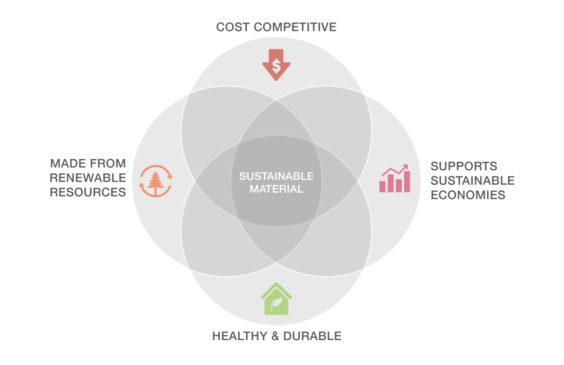
In addition to bringing a superior building material to the market at a competitive price, manufacturing insulation directly from wood fiber has the potential to greatly benefit the economy of rural Maine. The most heavily wooded state in the U.S., Maine has a long history of forest products manufacture and a highly skilled workforce. But changes in the pulp and paper markets have led to shuttered mills, layoffs for thousands of workers, and the loss of over $1 billion in annual economic activity since 2014.
Wood fiber insulation is made from the same softwood chips as paper, a lumber mill byproduct that is now in surplus by up to 4 million tons annually. Redirecting that stream of raw material and repurposing idle industrial capacity to the manufacture of a sustainable, high performance building material represents a golden opportunity to create clean, new-economy jobs and revive a declining rural economy.
For GO Logic and GO Lab, this effort highlights the linkages—among architecture, building science, climate science, natural resources, and industrial economics—that we must activate in order to create the coming generation of environmentally regenerative, carbon-negative buildings.
