

19 Jun Pushing the Boundaries of Building Performance
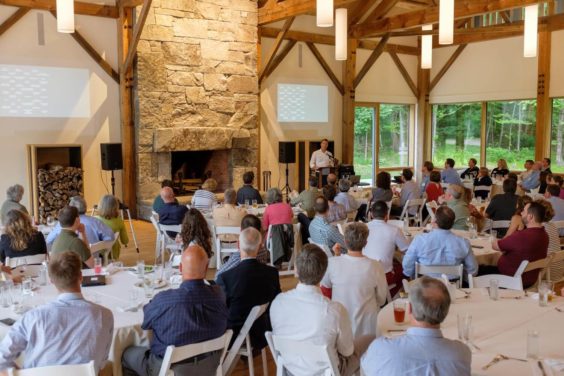
GO Logic partner and principal architect Matt O’Malia addressed a group of New Hampshire AIA members last week, presenting a continuing education course on his firm’s evolving approach to high performance design and construction. Speaking in GO Logic’s recently completed Alnoba retreat center, Matt led the group on a deep dive into the design, detailing, and energy modeling of the very building in which the session took place. A 13,000 square foot, mixed-use structure that incorporates innovative structural and mechanical systems, Alnoba broke new ground for Passive House design in North America, which has focused predominantly on less demanding residential projects.

Photographer: John Hession, Hon. AIANH
GO Logic’s basic building performance strategy prioritizes building envelope investments like triple-glazed windows, superinsulation, and air-sealing to reduce the size, cost, and operating expense of mechanical systems. The formula is simple in concept, but it takes on considerable complexity when applied to a building of this size and type. Matt shared the energy models, construction details, and test procedures that yielded the building’s near-zero energy performance, as well as some crucial lessons learned in taking the design through execution and delivering a building that performs as planned.
Matt also provided a glimpse of GO Logic’s current direction. Aiming to transcend the laudable but static goal of sustainability, the firm has targeted a “regenerative” standard of building performance, which demands that buildings and infrastructure produce more energy than they consume. Regenerative performance allows buildings not only to achieve carbon-neutrality in operation, but also to offset within their lifespan the carbon released in their production.
GO Logic’s R&D company, GO Lab, is working to bring that goal closer. Its current front-burner project is developing domestic manufacturing capacity for wood fiber-based insulation boards and batts that will cost-effectively supplant the energy-dense fossil fuel-based products that currently dominate the market. The result will be reduced operational energy use, less environmental impact in production and disposal, stronger local forest economies—and low-embodied-energy buildings that start life with less energy debt and a shorter path to life-cycle energy neutrality.