

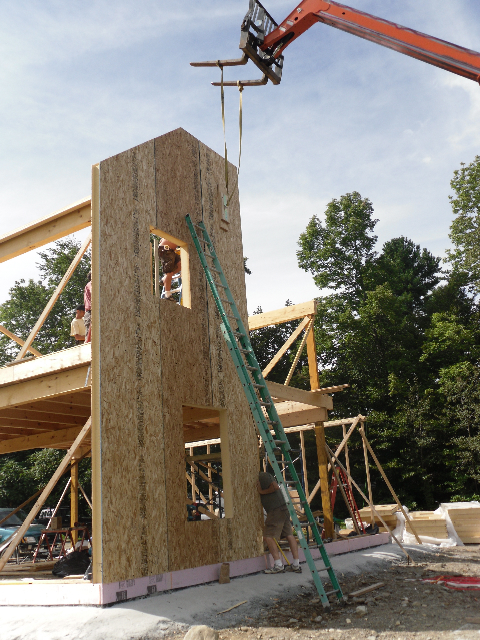
18 Sep Structural Insulated Panels (SIPs)
 The structural insulated wall panel systems (SIPs) have many advantages when creating a well-insulated and air-sealed building shell that is cost effective to produce. The panels we chose to use on the prototype are 6-inch thick urethane panels, that are 4 feet wide by 24 feet long, factory manufactured and pre-cut by Winterpanel in Vermont. The most significant advantage of the SIPs is that they provide an uninterrupted thermal barrier for the shell that is also a durable and easily sealed air barrier.
  The Passive House requirements for a building’s shell are very specific. To qualify for Passive House Certification, a building should not have any thermal bridges in the foundation or building shell, and the building, when complete, must meet strict air sealing requirements verified by a blower door test. The SIPs system has allowed the prototype’s construction to conform to these Passive House requirements, while still allowing for simple and cost effective construction.
  The second advantage of the SIPs system has to do with the size of the panels and the ability to have them factory pre-cut to fit each building design. These benefits are maximized by utilizing our computer designs in the actual production of the construction components. By utilizing advanced three-dimensional computer models, we are able to coordinate all the expensive building shell components (including windows, SIPs and structural frame), and then incorporate the computer’s accuracy in the actual construction process. By putting emphasis on planning and leveraging that in the construction, we can improve the speed, accuracy, and quality of the site work.
  One frequently asked question regarding SIPs panels is the environmental impact of the foam insulation used in the panels. The three standard foam types used in SIPs panels are urethane foam, and Expanded Poly Styrene (EPS). We choose to use urethane foam for the prototype’s panels because it has a higher R-value per inch, resulting in a thinner panel and a higher total R-value per unit cost. The criticism of this foam type is that the R-value decreases over time. The total aged R-value of the urethane, however, is still higher than the comparable EPS R-value per unit cost. While both foam options are considered green products according to the USGBC, it has been suggested that the EPS production is more environmentally friendly of the two foams. G•O Logic has used both foam types and considers their application on a case-by-case basis. You can read more blog posts about the GO Home here.